VALUES IN ACTION

Most organisations have values, but few actually use them properly – in my opinion.
This isn’t because people are cynical, but rather because the conditions that make values real – clarity, consistency, consequence – were never properly built.
Values aren’t just a statement of intent, a brand asset or a recruitment hook. At their best, they’re the thing your people reach for when a decision isn’t obvious, a filter for behaviour when no one’s watching and the right call isn’t the easy one.
The gap between your stated values and your lived culture is where trust is won or quietly eroded. Get it right, and culture becomes a genuine competitive advantage. But get it wrong and risk your people becoming disillusioned and disconnected.
If this introduction rings true for your business, then here’s some good news – we’ve got some best practice guidance coming right up.
Hear ye, hear ye, it’s another edition of employee experience commandments.
Viable values:
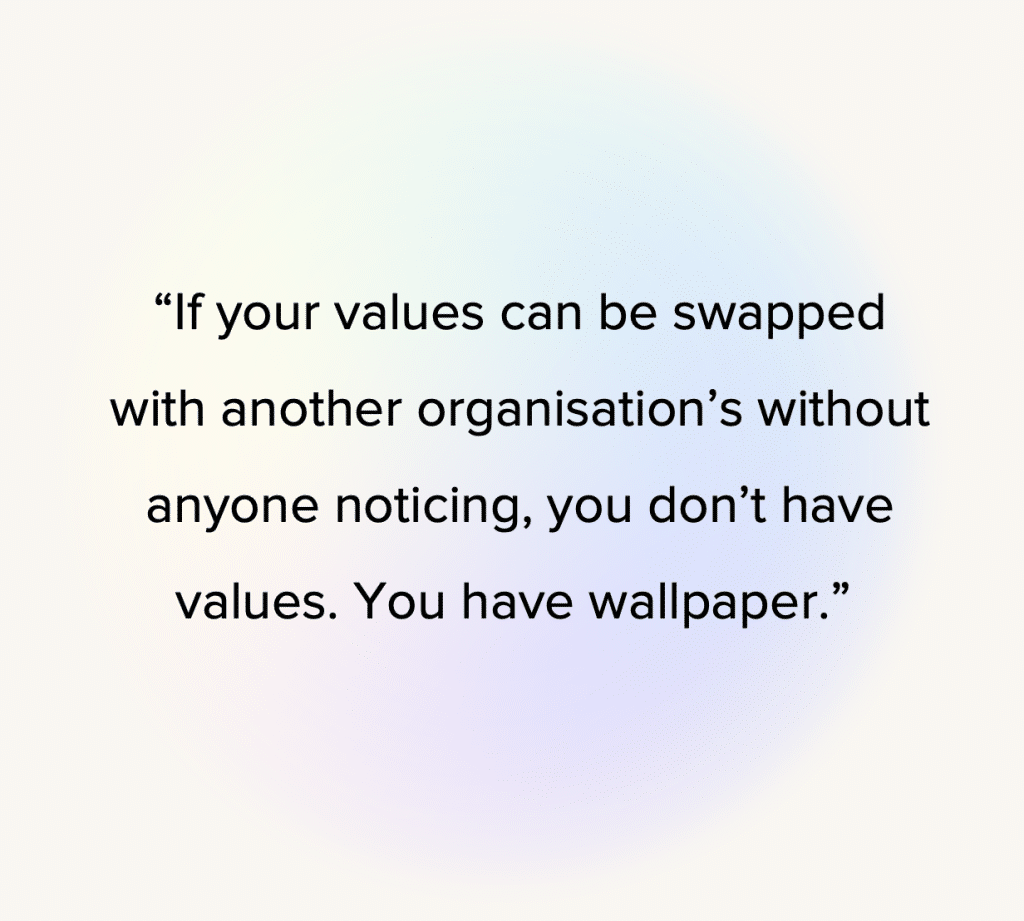
Most organisations write their values as if it’s a mission statement, but real values are designed, tested and co-created with the people who live them. A value only has power when people can relate to it. There’s a delicate balance in capturing something that feels accurate, while still supporting business aspirations for a brighter future. And if your values can be swapped with another organisation’s without anyone noticing, you don’t have values. You have wallpaper.
- Thou shalt build with, not for
Values crafted in boardrooms rarely survive reality. The people who live your culture every day must shape the values that define it. Listen. Listen more. And listen again. Include voices from every corner of the organisation so you’re co-creating values that feel lived-in rather than marketing-twee. - Thou shalt not chase clichés
Integrity, excellence, teamwork: vanilla buzzwords seemingly filled with optimism, but so generic they’re actually hollow and meaningless. To truly guide behaviour, you should choose language that’s distinct, specific and reflective of who you really are. - Thou shalt turn values into verbs
Values aren’t slogans. Think of them more as instructions. If people can’t picture how the values slot into their day-to-day, then it’s not actionable (and we’re back to the wallpaper analogy). Try translating values into behaviours, decisions and habits so your people know exactly what good looks like and how they can live it.
Say-do gap gaffes
Pressure reveals character. In moments of tension, your people aren’t listening to what you say your values are; they’re watching how you behave. Think of the uncomfortable moments, such as budgets tightening, whispers filling the communication gaps or business decisions landing awkwardly. The real test isn’t whether you have values – it’s whether you live them.
- Thou shalt honour values when it’s least convenient
Anyone can live your values on a good day. The real commitment shows up when the right thing is the harder choice: when fairness feels costly, when inclusion feels complex, when leadership scrutiny intensifies. Choose the value‑aligned path, especially when it stings – that’s how you cement credibility.
- Thou shalt close the say-do gap
Nothing destroys trust faster than leaders whose words and actions don’t match. When you promise transparency but communicate in half‑truths, people notice. When you preach fairness but make decisions behind closed doors, people talk. Back up every message with behaviour – not bravado. - Thou shalt not hide behind corporate fog
Euphemisms, vagueness and overly polished statements don’t soothe people. They signal danger. When pressure rises, clarity is an act of integrity. Explain what’s happening, why and what it means for people. Clarity is kinder than spin.
Smart systems
And finally, ingraining values is where most organisations tend to fall short. Values don’t fail because people don’t understand them; they fail because the organisation rewards something else. Ensure the say-do gap is plumbed into how your business lives and breathes, making the values a North Star for the right behaviour (not just a gentle suggestion).
- Thou shalt align rewards with values
If performance is rewarded without regard for how it’s achieved, your values are optional. Promotions, bonuses and recognition must reinforce the behaviours you claim to care about.
- Thou shalt hire and fire by the values
Values aren’t real if they don’t influence who gets in and who stays. Tolerating high performers who don’t embody your values sends a louder message than any town hall ever could.
- Thou shalt embed values in decisions, not just comms
Use your values as criteria in real decisions: trade-offs, prioritisation, risky calls. If they’re not part of how you make decisions, they’re just fluffy theatre.
- Thou shalt measure what matters
What gets measured gets managed. If you don’t track your values (qualitatively or quantitatively), they can’t and won’t compete with financial or operational metrics.Author’s note: This is a recurring point of tension for internal communications and HR. Leaders may dismiss efforts or proposals if you can’t back up your work or aspirations with meaningful data. That’s why we look at the employee experience ecosystem analytically, building a business case for why it matters.

Why it matters
To sum up, think of values as the rules people use when no one’s watching. If you create a positive culture that understands, lives and breathes your values, then they’ll become what I mentioned upfront: a filter for decisions when a choice isn’t obvious.
When values are clear, lived and reinforced, you’ll gain consistency. Decisions speed up, trust deepens and your people know where they stand and what’s expected of them.
Without lived values, something else takes over – shortcuts, internal politics, outdated practices – backed up with the flimsy excuse that “We always used to do it this way.”
So ask yourself:
- Are your values a competitive advantage that unites your people and your business strategy?
- Or do you need to close the say-do gap by making sure your values feel credible, motivational and relatable?
At scarlettabbott, we obsess over improving the world of work.
We know that values play a critical role in the employee experience ecosystem. Our strategists and creative studio can help you to surface new values, embed existing values, perform a culture audit and everything in between.
So if you’d like a friendly ear or some words of wisdom, you know where we are.
Written by Frazer MacRobert, Client Partner.