Performance Management: From Obligation to Opportunity

For many managers and employees, the term conjures up annual forms, awkward conversations and a process that only seems to appear when something has already gone wrong.
Recent moves by big names such as Meta and Amazon highlight a renewed focus on performance accountability and differentiation. After a year marked by significant restructuring, many organisations are now looking to review and redesign their performance management frameworks to reflect the new shape of their business. At the same time, there’s a growing recognition that traditional performance models no longer meet the needs of today’s workforce or modern firms.
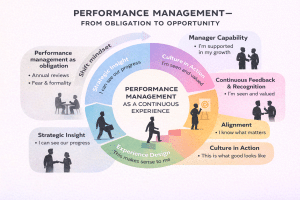
Progressive organisations are reframing performance management not as a corrective mechanism, but as a strategic lever. Done well, it shapes culture, aligns people to purpose and creates the conditions for sustained performance, engagement and resilience. Crucially, it also plays a central role in whether employees feel valued, recognised and motivated to stay.
Moving beyond “performance management as intervention”
Too often, performance management is treated as something that “kicks in” when targets are missed or behaviour becomes problematic. By that point, trust may already be eroded and outcomes harder to shift. In reality, performance management should be working quietly and consistently in the background of employee experience, guiding focus, reinforcing expectations and supporting growth long before issues arise.
When performance management is positioned as an ongoing partnership rather than a periodic judgement, it becomes a source of clarity and confidence rather than fear: becoming a reason to stay rather than a signal to leave. It also becomes a powerful retention lever. Employees are far more likely to stay where their contribution is noticed, acknowledged and connected to something meaningful. This is the mindset shift many organisations now need to make.
Culture is created, not managed
Culture isn’t shaped by slogans or values posters: it’s created through everyday signals about what really matters. And performance management is one of the strongest of those signals.
More than reviews and ratings, performance management communicates which behaviours, mindsets and ways of working are truly valued. When organisations intentionally embed desired behaviours into goal setting, feedback and recognition, they see more consistent decision making (what gets recognised gets repeated), stronger collaboration and higher engagement. Conversely, when performance systems reward outcomes at the expense of behaviours, culture suffers.
In this sense, performance management is a big part of culture in action.
Alignment drives results
Even high-performing employees can work at cross purposes without clear alignment. Effective performance management connects individual goals to team priorities and broader business outcomes, ensuring people understand how their contribution matters.
Alignment creates focus. It helps employees prioritise effort, managers allocate resources more effectively and organisations move in a coherent direction. It also provides transparency: when priorities shift, performance conversations offer a natural forum to reset expectations and adapt goals in real time.
In fast-moving environments, this alignment is no longer a “nice to have”, it’s essential.
Continuous feedback builds trust and capability
It’s long been recognised that annual reviews alone are not sufficient to drive performance or engagement. Employees respond best to frequent, actionable feedback that supports development, recognises contribution and addresses performance issues early.
Continuous feedback strengthens trust. It normalises performance conversations, reduces surprises and reinforces positive behaviours when they happen, not months later. It also allows organisations to celebrate what good looks like, embedding those traits more deeply across teams. Recognition plays a critical role here – not as a reward mechanism, but as a way of affirming effort, progress and impact in real time.
Done well, this builds a strong sense of belonging. People feel seen, valued and connected to their teams and leaders, which in turn drives higher engagement and discretionary effort.
Importantly, early feedback prevents small issues from becoming big ones, shifting performance management from reactive to preventative.
Experience matters more than ever
Performance management is an experience, and experience design matters. Clarity, transparency, fairness and usability all directly affect engagement and adoption.
When processes are overly complex, inconsistent or poorly supported by technology, they create frustration and disengagement. When they are intuitive, meaningful and clearly linked to growth, employees and managers are far more likely to engage with them positively.
Technology plays a key role here, not as the solution in itself, but as an enabler that supports goal setting, feedback and insight in a seamless and human-centred way.
Manager capability is critical
Even the best designed systems fail without capable managers. Leaders who are trained and empowered in coaching, recognising contribution and guiding performance create higher engagement, stronger retention and better outcomes.
To reframe performance management, businesses must focus as much on manager capability as employee outcomes. Training managers to have effective conversations, give meaningful recognition and feedback and address challenges constructively is one of the best investments organisations can make.
When managers feel equipped rather than exposed, fear dissipates and performance conversations become part of everyday leadership.
Turning insight into advantage
Finally, performance management creates rich, data-driven insight. Trends in goals, feedback and outcomes reveal where capability gaps exist, which talent is emerging and where systems may be unintentionally misaligned.
Organisations that use this data strategically can spot issues early, make better people decisions and continuously improve both their performance frameworks and the employee experience itself.
Turning over a new leaf
Performance management is ripe for reinvention. The opportunity for organisations is clear: move away from fear-based, episodic processes and toward a system that supports alignment, recognition, growth and trust.
When performance management is designed as a positive, continuous experience – one that recognises contribution and reinforces belonging – it stops being something people dread and starts becoming a source of clarity, confidence and competitive advantage.
And that is where performance management truly earns its name.

Next Steps: Performance Management as Opportunity
- Reframe Purpose: Shift from compliance to a system that drives alignment, culture and growth.
- Design Around Key Moments: Make goal setting, feedback and recognition continuous, meaningful and human centred.
- Signal Culture Through Behaviour: Reward behaviours and mindsets, not just outcomes.
- Enable Managers: Build confidence in coaching, feedback and recognition.
- Simplify the Experience: Reduce complexity: ensure processes and technology support engagement and encourage innovation.
- Leverage Insight: Use performance data strategically to inform decisions and drive continuous improvement.
For organisations exploring these opportunities, we’re happy to share perspectives or discuss practical next steps.

Feel free to contact Hayley Exon, Director of Consultancy: hayley.e[email protected]